Posttraumatic stress disorder mitigation in trauma patients: An evidence-based systematic review from the Eastern Association for the Surgery of Trauma
Published 2025
Citation: J. Trauma. 99(): , May2025
Author
Kartiko, Susan MD, PhD, FACS; Atahar, Jayati MBBS, MPH; Rattan, Rishi MD; Zebley, James A. MD; Tatebe, Leah C. MD; Perea, Lindsey DO, FACS; Ruggiero, Kenneth J. PhD; Levett, Paul MSc, MA Ed; Wassertzug, Deborah MLS; Koenig, Susan MA; Mashbari, Hassan MD, DABS; Smith, Randi N. MD, MPH; Hink, Ashley B. MD, MPH; Allee, Lisa LICSW, MSW; Ortiz, Damaris MD, FACS; Hai, Shaikh A. MD, FACS; Butler, Caroline MD, FACS; Prince, Hillary MD, MS, FACS, CNSC; Murphy, Patrick MD, FACS; Teichman, Amanda L. MD, FACS
Background
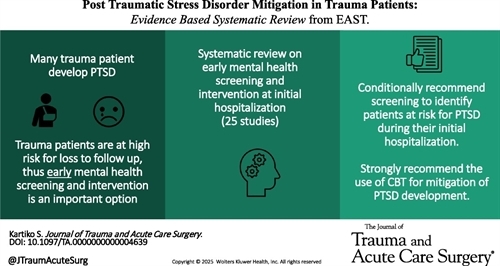
Because of advances in trauma care, there has been increased survival among trauma patients. However, less progress has been made to address posttraumatic psychological disorders. Many trauma patients (19–42%) report emotional or psychological distress after injury, and over one in five will develop posttraumatic stress disorder (PTSD) and/or depression within the first postinjury year. We aim to establish a practice management guideline using a systematic review to provide guidance on early identification of individuals at risk for PTSD and evidence-based treatment options to assist our patients to mitigate the development of PTSD.
Methods
Clinically relevant questions regarding screening of and intervention for PTSD in adult trauma patients with clearly defined patient Population(s), Intervention(s), Comparison(s), and appropriately selected Outcomes were determined. A systematic literature review was conducted for the period of January 1, 1996, to September 9, 2023. The quality of evidence was assessed using Grading of Recommendations Assessment, Development and Evaluation methodology. The working group reached consensus on the final evidence-based recommendations.
Results
The literature search yielded 9,387 studies, of which 25 met the criteria for inclusion. Screening and interventions were mostly successful in the identification and management of acute stress disorder/PTSD. The use of cognitive behavioral therapy was the most successful therapy, especially when used with high-risk individuals.
Conclusion
We conditionally recommend screening to identify patients at risk for PTSD during their initial hospitalization. We strongly recommend the use of cognitive behavioral therapy for mitigation of PTSD.
Level Of Evidence
Systematic Review/Meta-analysis; Level II.