The effect of ridesharing services on motor vehicle crash outcomes: A systematic review and practice management guideline from the Eastern Association for the Surgery of Trauma
Published 2025
Citation: J Trauma. 99(1):135-142, July 2025
Author
Kaufman, Elinore J. MD, MSHP, FACS; Jung, Hee Soo MD, FACS, FCCM; Teichman, Amanda MD, FACS; Colosimo, Christina DO, MS; Brewer, Jennifer M. MD; Perea, Lindsey L. DO, FACS; Dultz, Linda MD; Dvorak, Justin MD; Lu, Ning MD, FACS; Weston, Raquel MD; Kartiko, Susan MD, PhD, FACS; Qiu, Kefeng Maylene MLIS; Rakhit, Shayan MD; Murphy, Patrick MD
Background
In addition to their convenience, ridesharing applications (apps) have the potential to offer a safer transportation alternative, especially in situations involving intoxication. Their use may lead to reductions in crash-related injuries and deaths, particularly due to alcohol-impaired driving. Several observational studies have aimed to assess the impact of ridesharing on alcohol-impaired driving, crashes, and deaths. Our goal was to systematically review the literature to inform policy makers and public health practitioners on the use of ridesharing apps in the reduction of crash injuries and deaths.
Methods
We performed an evidence-based systematic review using the Grading of Recommendations Assessment, Development, and Evaluation methodology to answer the following population, intervention, comparator, outcomes questions: (1) For the general population, should the presence of ridesharing services compared with no ridesharing be recommended for reducing motor vehicle crash (MVC)–related harms? (2) In the general population, should more versus less use of ridesharing services be recommended for reducing MVC-related harm? Our project was registered with the PROSPERO registry of systematic reviews and meta-analyses (CRD42023407489). We searched literature published from January 1, 2009 (first ridesharing app available), through December 31, 2022, using PubMed, web of science, and Scopus.
Results
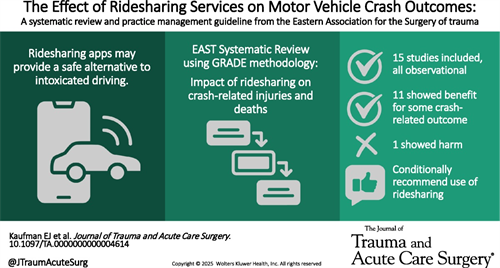
Fifteen studies met the criteria for inclusion, covering a variety of geographies, populations, and methodological approaches. All evidence was observational, and overall quality of evidence was low. However, most studies (N = 11) showed benefit of ridesharing services for specific outcomes, with only one study indicating harm (increased total MVCs).
Conclusion
Based on the available evidence, ridesharing may have a valuable role to play in reducing MVC-related harm. Public policy should consider ridesharing apps in the broader scheme of efforts to reduce driving-related morbidity and mortality.
Level of Evidence
Systematic Review; Level III.